


The Salt Saga: 700 Years Underground
Miners were digging salt out of the ground beneath Wieliczka two centuries before Columbus sailed. The mine, just outside Kraków, Poland, kept producing for more than 700 years, and its miners carved out roughly 180 miles of tunnels and nearly 2,500 chambers along the way. For almost half that time, they’ve had company.
Kraków itself is a great city for history and adventure lovers alike, but the real find is just outside the city, a short bus or train ride from the famous Old Town. Wieliczka is a town of fewer than 30,000 people, with cafes, restaurants, and a history tied to the mine from the very start. Today, the headframes of a handful of vertical shafts rise among the Gothic, Baroque, and Neo-Renaissance buildings scattered across town.
When I visited, I chose the Tourist Route, one of the mine’s two main tours, because it covers more of the chambers and the miners’ craftsmanship. The other option is the Miners’ Route, which starts from a separate shaft and trades some of the history for hands-on detail. You suit up in mining gear, test for methane, and even cut some salt yourself while learning how the mine operated until 1996, when full-time extraction came to a halt.
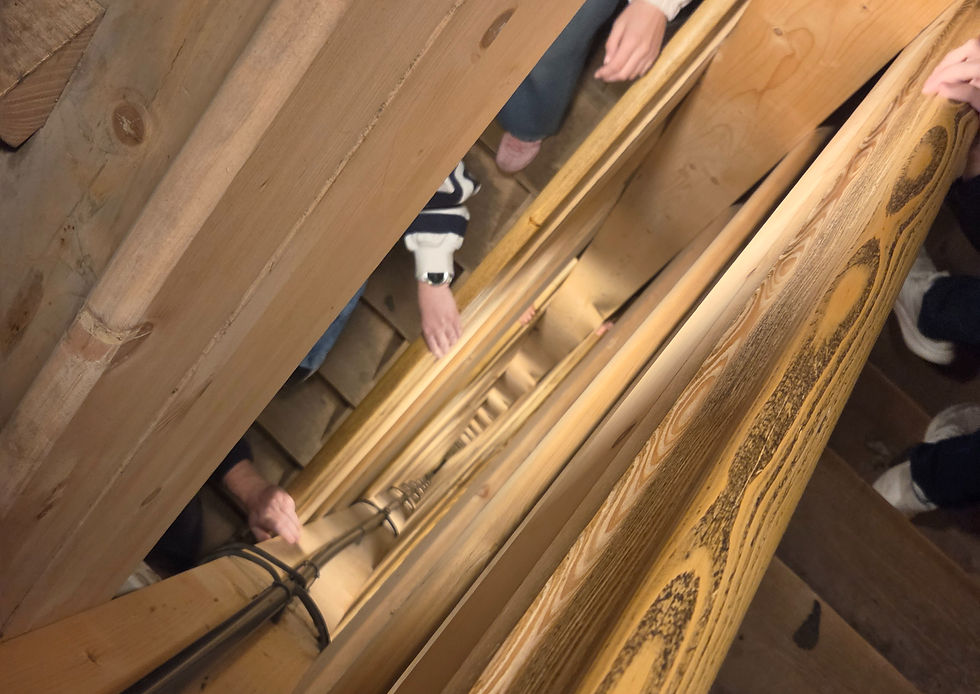
The Tourist Route begins with a guide leading you down 380 wooden steps in the Daniłowicz Shaft, depositing the group on the mine’s first level, about 210 feet into the earth. Every step put me in good company. Tourists have been filing down into this mine since the early 1700s, since before the United States was even a nation.
The first thing I noticed down there was the cool air, around 64 degrees no matter the season, and how dim it was compared to the daylight we'd just come from. I felt strangely alone, even surrounded by dozens of other tourists. I drifted toward the back of the group, peering around the next corner and trying to deduce where we'd go next. After exploring so many old mining ghost towns across the West, where the mines themselves are usually sealed off or too dangerous to enter, I was thrilled to finally be inside one.
Seeing a wooden door behind me, I backed into the hallway that led toward it. Instantly, I felt a rush of cold air, like a massive industrial fan was blowing right at me. Even weirder, the air was dead calm just a few feet away. The folks standing a few feet in front of me didn’t have a hair out of place. I’d never felt air movement change that abruptly, and I’ve spent plenty of time in agricultural drying bins and curing rooms built entirely around moving air.
I figured the air must have been pumped down the shaft and into the mine, since that’s the only way fresh oxygen could reach those passages and keep miners, and us, alive. But I couldn’t figure out how it was getting down the shaft, over all our heads, and then picking up speed right behind the group. I knew the mine would be stranger than most anything I’d seen, but a mystery that soon had been unexpected.
Our tour guide began her talk by telling the group to stick close. She said many of the old tunnels are still unlit to this day, and you wouldn’t want to end up alone in the dark down there, especially if you've seen The Descent.
After the first chamber, we passed through a gasket sealed heavy wooden door. Suddenly the draft a moment earlier made some sense. The air passages must have had their own intake in that first chamber connected to the shaft. An airlock kept the incoming air flowing at a steadier rate instead of sweeping through the whole mine at breakneck speed from the intake motor. The door behind us had to close before the next one would open. A few of us tried to force the next door while the first was still open, just to see, but the pressure held it shut. Even the strongest folks in our group could barely budge it.
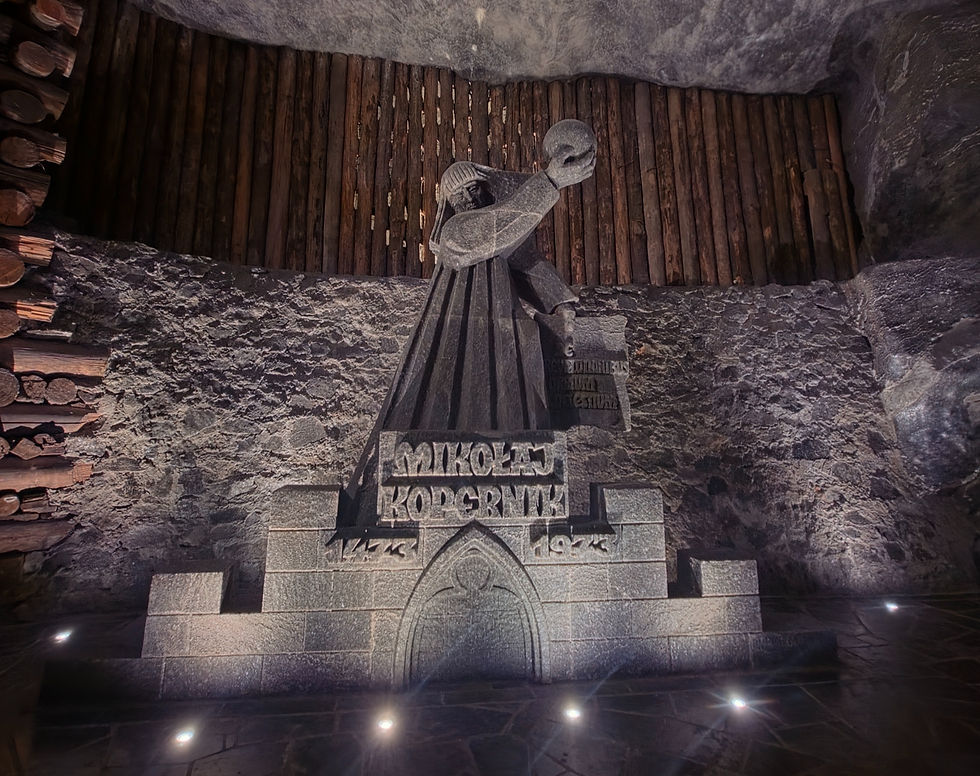
In the next chamber, we were greeted by our first subterranean sculpture: a statue of Nicolaus Copernicus. As a student at the Kraków Academy, the young scientist is believed to have visited the mine in 1493, earning him the title of the mine’s first “tourist.” The chamber is named in his honor, and the statue pictured above was carved from salt by Władysław Hapek in 1973 to mark the 500th anniversary of his birth.
Most of the chamber is carved from a block of what’s called green salt, though it looked more like a semi-translucent dark gray in person. When I shone a light across it, the glow shifted from dark to bright as the beam moved through the salt. In spots, even the floor was salt, worn incredibly smooth.
Next, we stepped into the Janowice Chamber, where salt sculptures act out the legend of how salt was first found here. As the story goes, Kinga was a young Hungarian princess when she became engaged to Duke Bolesław of Kraków. Her father offered a dowry of gold and jewels, but Kinga wanted something more useful to her new people. Poland had nearly everything it needed except salt.
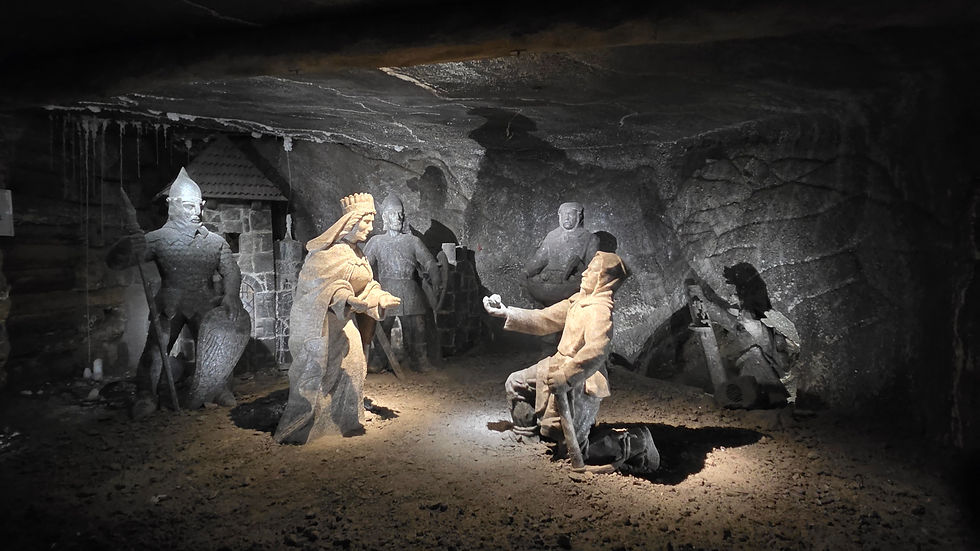
In a time before refrigeration, salt was what kept meats and cheeses from spoiling, so for Kinga it was worth more than gold. Her father gave her the largest salt mine in Hungary as her dowry. Once she was there, though, Kinga realized she had no way to transport enough salt all the way to Poland. As the story goes, she prayed for a way to get salt to her new people, and God told her to throw her engagement ring down one of the mine’s shafts. So she did.
Soon enough it was time for Kinga to meet her new husband, so she traveled to Bolesław’s court in Kraków. Along the way, she looked over her future lands, with a few Hungarian miners she’d brought along as attendants. Stopping near Wieliczka, she ordered the men to dig. They moved earth all day until they hit a big rock that halted their progress. Then Kinga asked them to chip a piece off.
After a moment, she recognized it as rock salt. When the miners broke it open, out came the same engagement ring she’d thrown into the earth in Hungary. From that hole, the Wieliczka Salt Mine was born. It’s one reason Kinga, later canonized as a saint, became the patron saint of salt miners.
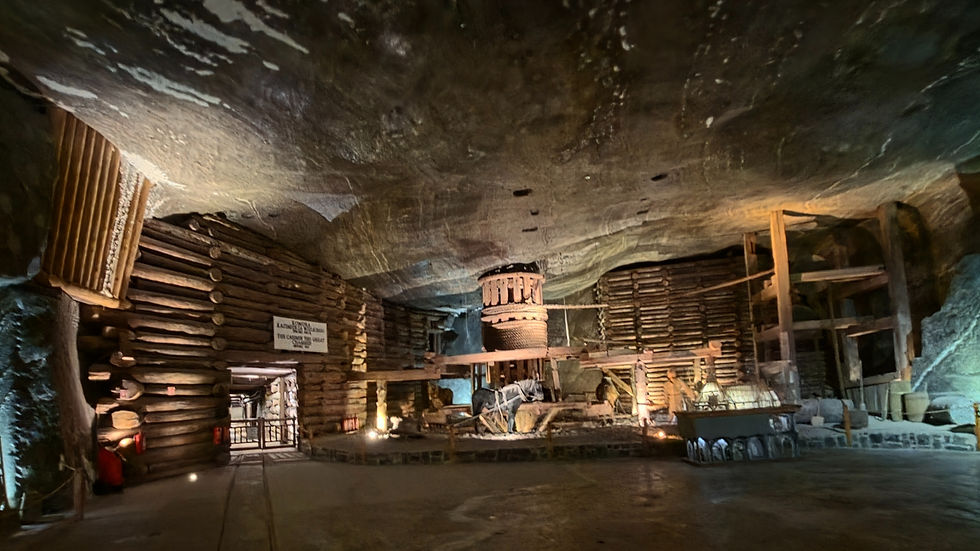
Past that chamber, we continued down the passages to learn how the mine was actually worked. The walls were mostly rock salt in varying shades of gray, smooth to the touch. I wondered how many hands had run along them over the centuries. Salt is naturally hygroscopic, meaning it pulls in moisture, and even the sweat from a hand can dissolve it bit by bit. I wondered if the passages I was walking through had been an inch or two narrower 500 years ago, before the tourists came.
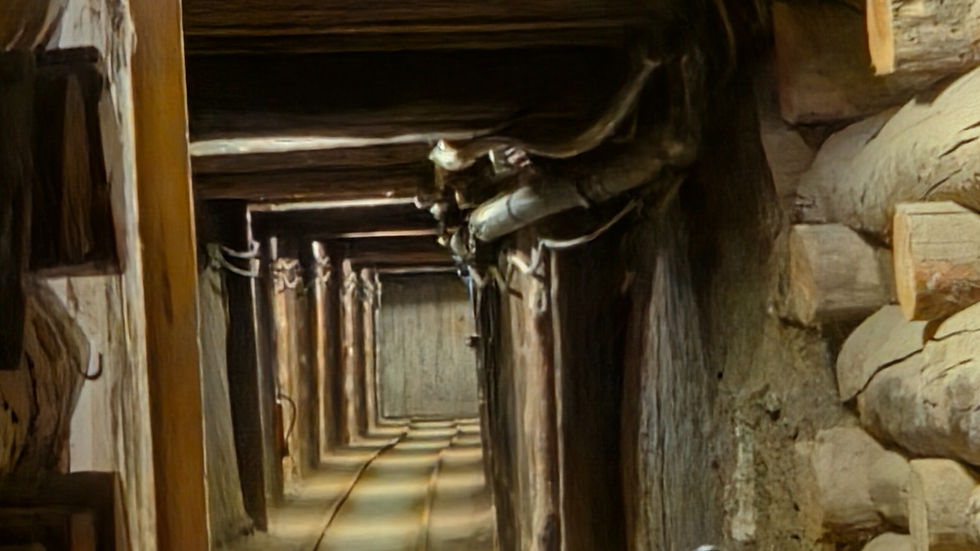
Massive timbers shored up the shafts and the walls of the larger chambers, stacked like the walls of a log cabin, as seen on the left in the photo above. Other chambers had patches of concrete to reduce the risk of debris falling from the ceilings high overhead. The same chamber pictured above held a stable for the horses. They were brought down in the 16th century to haul salt and power the hoists that lifted it to the surface. Miners would keep digging by hand for centuries more, but at least the horses took some of the hauling off their backs.
In the Spalone, or “Burnt,” Chamber, our guide explained one of the most perilous jobs in the mine. Before each shift, a few miners known as Penitents went ahead to burn off any methane that had built up overnight. Methane is lighter than air, so it collects in pockets along the ceiling. Dressed in wet clothing and carrying torches on the ends of long wooden poles, the Penitents crawled along the floor, staying as low as possible so the flash of burning gas would roll over them. Going off memory alone, they crept into passages that would have been completely dark, sweeping their flames along the roof of each section. Since methane is colorless and odorless, there was no better way to find it. It was dangerous work in a dangerous place.
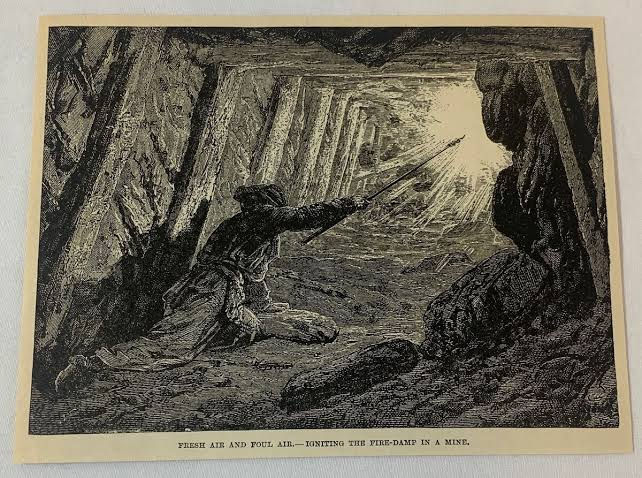
Occasionally, a pocket was so large that it sent a shock through the passage, and flames leapt down from the ceiling at the unlucky soul who had found it, like a demon from the underworld. These were some of the bravest men in the mine. According to our guide, nearly a third of them lost their lives doing the job.
Moving on from the Spalone Chamber, we followed a long passageway until it widened out at the top of a staircase. Below me, flight after flight of stairs switchbacked down into a huge cavern. It was time to descend deeper into the mine, toward a chapel carved entirely from salt.

Comments