


Diamondfield Jack & Castle Rocks
Jackson Lee Davis was an enforcer on the deadline. To the west of it, cattle country; to the east, sheep. Any animal or herder who crossed that line was in danger of the gravest sort. Enforcers rode the line day and night, often carrying a sidearm in addition to their rifle. That respect was often earned in powder and blood, fading away in the breeze and splattered across dry yellowing grass under a beating high-desert sun.
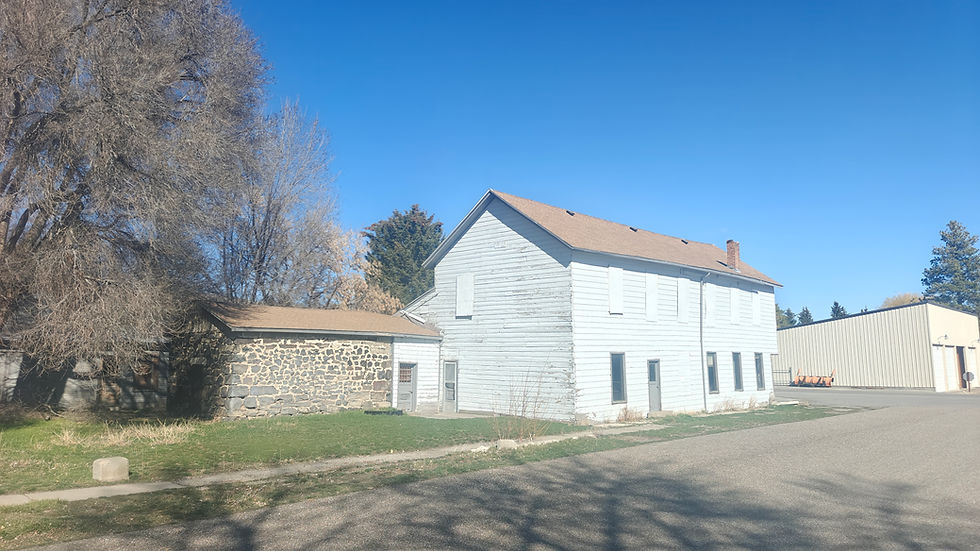
On my way south through Idaho and into Utah on the City of Rocks Byway, I found myself in Albion, Idaho. There, I stumbled onto a place that Jack once called home, if a jail cell meets that qualification. For six years, Diamondfield was penned up in the Cassia County Jail that stood in the park before me. These days it's a mix of wide open grass, horseshoe pits, and some fir trees.

The rest of town is quiet, with less than 300 residents. A weathered gray stone building with dark stone corner accents and a high eave extending out a good ways overhead sat on West Street. I found myself imagining outlaws on horseback riding under it during a winter downpour on a dark night. Another sight was an old Coca Cola advertisement hand painted onto the side of Hagar's Store, a general mercantile that operated in the earlier half of the twentieth century. The golden hue was surprisingly vibrant yet.
Standing there now, it was easy to forget the town once hosted some interesting characters. Diamondfield Jack, born as Jackson Lee Davis, lived an extraordinary life. His early years are a mystery but by the 1890s he was chasing silver and diamonds in Nevada. He talked so much of looking for them that it earned him a lifelong nickname, though he found none. By 1895, he worked for the Sparks-Harrell Cattle Company as an enforcer on the deadline. The company supported the use of violence, suggesting: "Don’t kill but shoot to wound if necessary...If you have to kill, the company will stand behind you – regardless what happens" (Albion Historical Society).

In February 1896, two sheepherders were found dead with gunshot wounds. People immediately suspected that Diamondfield Jack had something to do with it. Jack had been in gunfights with herders before, and he'd even allegedly bragged about wounding a sheepherder. In late January 1896, Jack and another night rider named Fred Gleason had shot it out with herders on another Sparks-Harrell ranch in southern Idaho. Though nobody was hit, they decided to leave the area and head south. When the two bodies were found further south near Albion two weeks later, people suspected Jack and Fred had been passing through the area at the time of the murders.
Over a year after the deaths, Diamondfield Jack was arrested in Arizona and brought to Idaho for trial. He was sentenced to hang on June 4th, 1897. In a separate trial with the same evidence, a jury found Fred Gleason not guilty. Same evidence, same night, two men; one walks, one hangs.
The defense attorney Hawley argued that the men could not have ridden from the murder site to a Sparks-Harrell ranch in Nevada where other cowboys saw the men have noon dinner. He had two cowboys re-enact the alleged ride, and it took them nearly six hours. It was possible, though they admitted winter would stretch that number long enough to raise some doubts. Based on this, a stay of execution was granted for a while. In June 1898, the Idaho Supreme Court overturned the stay. The new hanging date was set for October 21st.
On October 13th, Jim Bowers, a superintendent at the Sparks-Harrell ranch, came forward and admitted to murdering the two sheepherders along with his friend Jeff Gray. Despite signed affidavits by the men admitting to the murders, the Idaho Board of Pardons didn't care, and they tacked on another small delay to the execution. It was set for December 16th and then February 1st, 1899.
By 1899, Hawley was working the case through federal courts and got another stay of execution. Riders arrived with the news mere hours before Diamondfield was to be hanged. Soon after, the Idaho State Legislature made a new rule requiring that all executions take place at the state penitentiary. Jack was moved there for a few months, until the Idaho Supreme Court reversed the law the rule accompanied. I don't know how Jack kept his head through it all.

By late 1900, Diamondfield Jack's case had reached the ears of the United States Supreme Court. They declined to take on the case, however, because of procedural technicalities according to the South Idaho Press. After this, Hawley asked Cassia County for a retrial but they declined, and set a new execution date for June 21st, 1901. Around the same time, they declared that Bowers and Gray had acted in self defense when they shot the sheepherders, acquitting them of the same crime Jack had allegedly committed.
In the meantime, the state board of pardons was receiving dozens of letters that pled for clemency for Diamondfield Jack. Some of these letters were from friends in high places in Albion, and the pardon board delayed twice more.

By July of 1901, the board of pardons had been convinced to commute Diamondfield's death sentence to life imprisonment, moving him back to the state penitentiary. Hawley, tireless as ever, continued to fight for Jackson Lee Davis. On December 18th, 1902, Diamondfield Jack was finally pardoned for a crime that he didn't commit, if a crime was committed at all.
Jack soon left Albion behind, and headed for Tonopah, Nevada where he finally struck it rich in a gold streak; not the diamonds he'd chased, but it spent the same. As in many tales of the west, Jack found his fortune and then lost it all. Not much is known of his later life besides sightings in New York City, California, Montana, and Mexico. In 1949, he was hit by a taxicab while attempting to cross the street in Las Vegas, dying a few days later.
Moving on from Albion, I rolled my way south past the Jim Sage mountains, through poison hollow and the old settlement of Elba. Elba these days seems to have just one or two people around, and a lonely old church. After passing through, I headed for Castle Rocks, catching signs for the City of Rocks the whole way.

Turning off the Elba-Almo highway, my tires hit gravel and I soon came to a parking area with a historical sign beneath some big old trees just within Castle Rocks state park. It told the story of Mary Ann Eskelsen Jensen. She immigrated from Denmark at age 13 with her family on a five-week ship passage. The family then crossed a nation torn by civil war before making their way over the plains in a covered wagon in 1863. Mary Ann had to lay her youngest sister to rest on the trail.
Once they made it out west, Mary Ann married a man named John P. Jensen and they homesteaded on the spot where I was standing, building a 35x35 foot cabin along with a stable and corrals. They had fourteen children, though only six survived to adulthood. It was a hard life out west, but Mary left a lasting mark as a midwife and nurse for many years around Almo while also helping her husband run the store on their property.

On my way back to my truck, an older couple in a 90s Chevy truck pulled up and we started talking. They had been fishing at the pond close by after exploring Castle Rocks further down the road. They said the fishing was as good as the views, and I told them that I may have to try my luck. It was already early evening, we said goodbye after a few moments. I continued down the road with the gargantuan granite sentinels staring me down.
Parking the camper in a small lot in the middle of the junipers, I was now right at the base of the massive boulders. Though they seemed too large to be boulders at all. It was as if a meteor shower had pummeled the earth here and left it covered in granite head-knots, the kind Tom gets from Jerry.

I took to the trail, which was still damp from all the snowmelt. There were piles here and there in the shade, but it was nice out for early March, nearly 60 degrees even at that later hour. I wandered into the heart of some of the formations. Climbing over a notch between two tall slabs, I found myself walled in with a few trees as my only company. It was as if I was in the middle of a massive stone flower, its petals looming high above me.
I had the place nearly all to myself, only seeing a couple other small groups during the few hours I spent there. On the main trails, there were signs for turnoffs to climbing routes with names such as The Duke, True Grit, and Mini Muffin.

As it turns out, Castle Rocks is a fairly popular spot for rock climbing in the warmer months. I saw bolts in the walls at multiple spots throughout my hike, and those were just the ones I could see from the main trail. The array of sheer walls ringing the boulders made for some great private spots to climb within the shade of the junipers. I hope to go back sometime with friends and climbing gear and get after it.

The sun was getting lower and lower, throwing yellows and pinks across the sky. I took it all in, thankful to get to explore the place in the off-season. Making my way down the trail, I had questions. How many people had those rocks seen? Who was first up those routes, and when?
I continued snaking through the rocks before dropping down into the brush as the trail slowly turned back to the truck. All was calm in the evening air, and I had a smile on my face, renewed from the jaunt through the Castle. I hopped in the truck and headed back toward the highway and Almo.

On my way through Almo, I passed the Tracy store, which has been in continuous operation since 1894. It once sold everything from dry goods to farm implements to serve the local settlers. More than a store, it also hosted local dances, shows, and meetings; the Eames brothers who founded it had built out the second story for exactly that. These days it houses the post office. I was disappointed to find the doors closed when I stopped by.
Just down the road was the visitors center of Castle Rocks State Park and City of Rocks National Reserve. I picked up some maps and filled my water bottle as the sun began to set behind the hills west of Castle Rocks. It was time to find a camp spot for the night.

Sources:
Albion Historical Society . (n.d.). Diamond Field jack. Internet Archive. https://web.archive.org/web/20190904232130/http://www.albionidahohistory.org/albion-valley-history/diamond-field-jack/
Nettleton, L. (2026, June 14). America 250: Diamondfield Jack’s murder trial became Idaho’s trial of the Century. Idaho News 6 Boise Twin Falls (KIVI). https://www.kivitv.com/news/america-250-diamondfield-jacks-murder-trial-became-idahos-trial-of-the-century
Robinson, R. G. (1996, February 4). Diamondfield Jack’s Legal Saga: Sentenced to Hang . South Idaho Press.
Tracy Store. Almo Creek: Where the Pavement Ends and the West Begins. (n.d.). http://www.almocreek.com/tracy/


Comments